
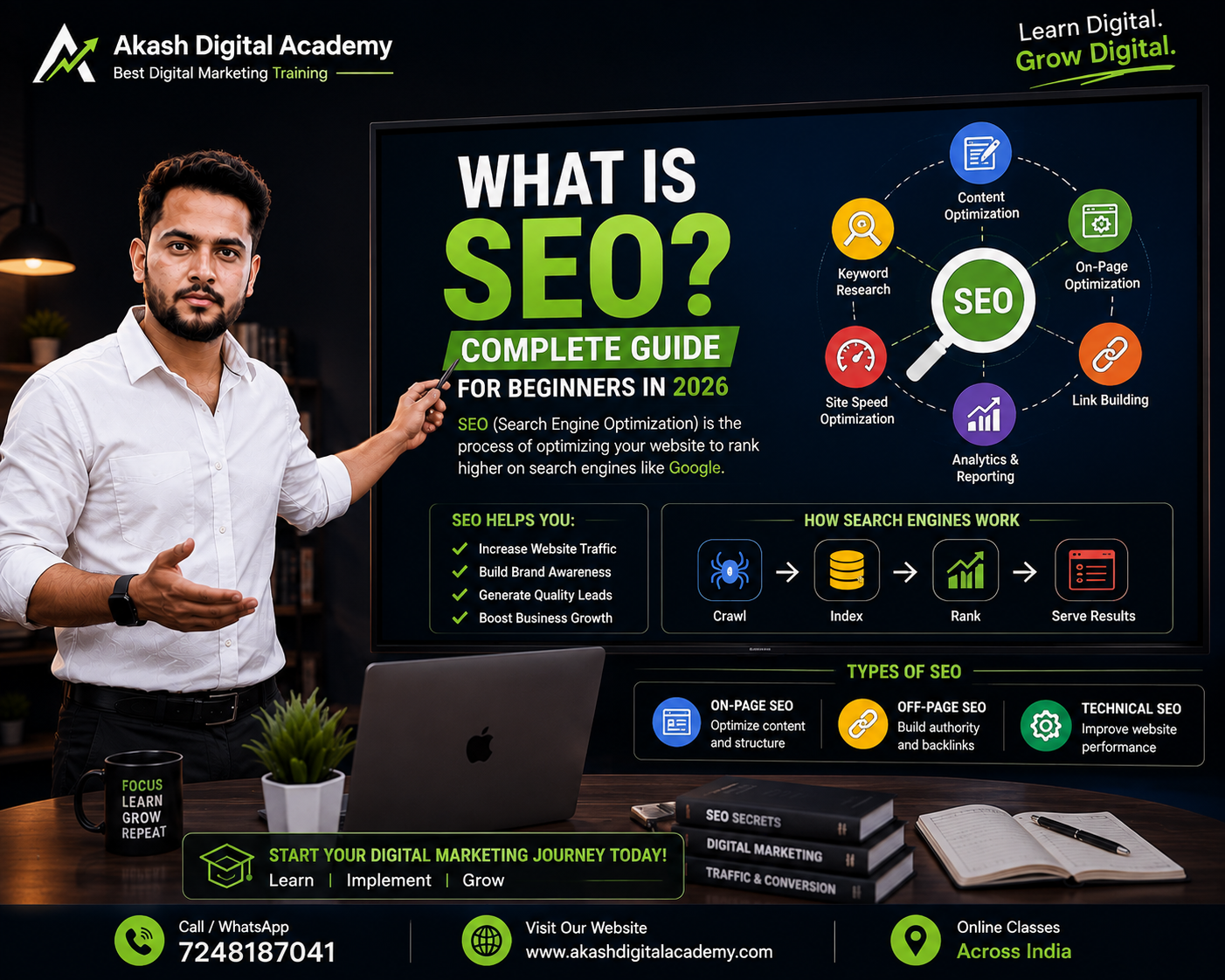
What Is SEO? Complete Guide for Beginners in 2026
What is SEO? Learn how Search Engine Optimization works, how Google discovers and ranks pages, how keyword research works, and how beginners can build an effective SEO strategy for long-term organic visibility, traffic and leads.
What Is SEO in Simple Words?
SEO stands for Search Engine Optimization. It is the process of improving a website's content, structure, technical performance and authority so search engines can understand its pages and show them for relevant organic searches.
For businesses, SEO can support organic visibility, relevant website traffic, lead generation and long-term online growth.
What Is SEO and Why Is SEO Important?
Search Engine Optimization (SEO) is a core part of digital marketing that focuses on improving a website's visibility in organic search results. When users search for information, products or services, search engines try to return pages that are relevant and useful.
A strong SEO strategy combines keyword research, search intent, useful content, website structure, internal linking, technical SEO, local SEO and website authority.
How Does SEO Work?
To understand how SEO works, beginners should first understand three important search engine processes: crawling, indexing and ranking.
1. Crawling
Search engine crawlers discover pages through links, sitemaps and other discovery mechanisms. Good website architecture and internal links help important pages become discoverable.
2. Indexing
After discovering a page, search engines process and evaluate its content before deciding whether it should be included in their index. Indexability and technical SEO therefore matter.
3. Ranking
When a user performs a search, search systems identify relevant indexed pages and determine which results are most useful for the query.
Website owners can monitor search performance and indexing using Google Search Console .
Types of SEO
A complete SEO strategy covers multiple areas. Each type addresses a different part of website optimization.
On-Page SEO
Optimize titles, headings, content, URLs, images, internal links and search intent.
Technical SEO
Improve crawlability, indexability, mobile usability, website architecture and technical performance.
Off-Page SEO
Build website authority through relevant backlinks, mentions, digital PR and genuine online relationships.
Local SEO
Improve visibility for location-based searches using Google Business Profile, local relevance and reviews.
Content SEO
Create useful, comprehensive content that satisfies search intent and answers real user questions.
SEO for AI Search
Create clear, useful and well-structured information that can be understood across modern search experiences.
SEO Keyword Research for Beginners
Keyword research helps you understand the terms and questions your target audience searches for. However, choosing keywords only because they have high search volume is not enough.
Consider relevance, search intent, competition, business value and the type of content users expect when selecting target keywords.
SEO Keyword Mapping Example
| Keyword | Search Intent | Recommended Page |
|---|---|---|
| What is SEO | Informational | SEO Beginner Guide |
| SEO course | Commercial | SEO Course Page |
| SEO course in Ghaziabad | Local Commercial | SEO Course / Location Page |
| SEO services in Ghaziabad | Transactional | SEO Services Page |
| how to improve Google ranking | Informational | SEO How-To Blog |
On-Page SEO: What Should You Optimize?
On-page SEO focuses on the elements present on your website. The title, headings, content, images, links and overall structure should clearly explain the purpose of the page.
SEO Title
Create a concise and descriptive title that accurately represents the main topic of the page.
Meta Description
Write a useful description that accurately summarizes the page and can encourage relevant searchers to visit it.
Heading Structure
Use one clear H1 and organize supporting topics using H2 and H3 headings. A logical heading hierarchy improves content structure and readability.
Internal Linking
Internal links connect relevant pages on your website. They help users discover related information and help search engines understand relationships between pages.
Technical SEO Basics
Technical SEO provides the foundation for search engines and users to access your website effectively.
- Keep important pages crawlable and indexable.
- Maintain a useful XML sitemap.
- Use descriptive and clean URLs.
- Fix broken internal links.
- Ensure good mobile usability.
- Improve page performance.
- Use canonical URLs appropriately.
- Keep website architecture logical.
What Is Local SEO?
Local SEO helps businesses improve their visibility when customers search for services or products in a specific location.
For local businesses, Google Business Profile, local relevance, customer reviews, business information and location-focused content can all be important parts of a local search strategy.
For a deeper local SEO strategy, read our guide: How to Rank Top on Google Maps: Complete Local SEO Guide .
SEO vs Google Ads
SEO focuses on organic search visibility, while Google Ads provides paid advertising opportunities. Both can support traffic and lead generation, but their costs, timelines and strategies are different.
Many businesses can combine SEO and PPC depending on their budget, competition and marketing objectives.
Read the detailed comparison: SEO vs Google Ads (PPC): Which Gives Better ROI? .
How to Learn SEO Step by Step
- Understand SEO fundamentals and search engines.
- Learn keyword research and search intent.
- Practice on-page SEO.
- Learn technical SEO fundamentals.
- Understand local SEO.
- Learn Google Search Console and analytics.
- Work on real website projects.
- Track impressions, clicks, rankings and conversions.
- Keep learning about modern search and AI-powered search.
SEO Career Opportunities
SEO skills can support several digital marketing career paths, including SEO Executive, SEO Specialist, Technical SEO Specialist, Local SEO Specialist, Content SEO Specialist and SEO Manager.
Professionals who combine SEO with Google Ads, social media marketing, content marketing, analytics and lead generation can develop a broader digital marketing skill set.
Common SEO Mistakes Beginners Should Avoid
- Keyword stuffing.
- Writing content only for search engines.
- Ignoring search intent.
- Publishing thin or repetitive content.
- Creating unnecessary duplicate pages.
- Ignoring technical SEO issues.
- Building irrelevant backlinks.
- Ignoring internal linking.
- Expecting instant SEO results.
How Long Does SEO Take to Work?
There is no universal timeline for SEO results. Results can depend on competition, website history, content quality, technical condition, authority, search intent and the consistency of optimization.
SEO should generally be approached as a long-term digital marketing strategy. Track organic impressions, clicks, rankings, indexed pages and business conversions to understand progress.
Professional Digital Marketing & SEO Courses
Want to learn SEO and digital marketing practically? Explore our professional courses designed to build job-ready digital marketing skills.
SEO Course
Learn keyword research, on-page SEO, technical SEO, local SEO and practical website optimization.
View SEO Course →Professional Digital Marketing Course
Build skills across SEO, Google Ads, social media, content marketing and digital analytics.
View Digital Marketing Course →Advanced Digital Marketing Course
Develop advanced skills for SEO, paid advertising, analytics, lead generation and digital growth.
View Advanced Course →Ready to Learn SEO Practically?
Build practical skills in SEO, keyword research, Google Ads, social media marketing, content marketing, analytics and lead generation.
Frequently Asked Questions About SEO
What is SEO in simple words?
SEO is the process of improving a website so search engines can understand its pages and show relevant pages in organic search results.
What is the full form of SEO?
SEO stands for Search Engine Optimization.
How does SEO work?
SEO involves making website content and structure easier for search engines to discover, understand and evaluate, while satisfying the user's search intent.
What are the main types of SEO?
Major areas include on-page SEO, technical SEO, off-page SEO, content SEO and local SEO.
Can beginners learn SEO?
Yes. Beginners can start with SEO fundamentals, keyword research, search intent, on-page SEO, technical basics, local SEO and analytics.
Does SEO require coding?
Basic SEO does not require advanced coding. However, understanding basic HTML and technical website concepts can be useful for advanced SEO work.
Start Your SEO & Digital Marketing Journey
Learn SEO, Google Ads, social media marketing, content marketing, analytics and lead generation through practical digital marketing training.
Explore Digital Marketing Course